Research · Thesis
SIGNET
A research thesis on turning every kind of signal — IP packets, Wi-Fi, Bluetooth, cellular, optical — into one spatially-aware layer, and finding patterns that only appear when signals are paired.
Thesis is private
Illustration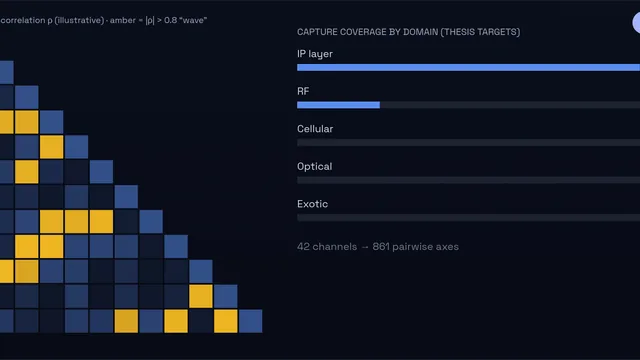
What it is
The central idea of SIGNET: signals contain patterns that are invisible in isolation and become visible when they are paired. Forty-two channels give 861 pairwise correlation axes.
The thesis is paired with a working prototype (NetWatch Next) and a playful front end (SIGSPACE).
What I built
- A 42-channel taxonomy across five physical domains: IP, RF, cellular, optical and “exotic” channels.
- The math of “behavior waves”: correlation between signal pairs over a time window and place, with candidate and confirmed thresholds.
- A live IP-layer experiment that surfaced several behavior waves within minutes.
- A vision document mapping every prototype feature to the thesis layers, with a gap analysis and a five-phase roadmap.
About the demo. The source is private, so this page describes the project at a high level. The visual above runs on invented sample data generated in your browser — nothing on this page comes from a real account, device, network or portfolio.